Pages

Showing posts with label books. Show all posts

03 November 2013

Compact Cabins by Simple Living


If you follow my facebook, you may have noticed that I put up a post about the Compact Cabins* book mentioned in the title.

Purely, by chance, I happened to see it while I was walking thru Lowes and was fairly impressed by it. However, I had no idea how cool it really was, until my loving in-laws gave it to me as a gift. So, lets go over the book a bit.


Honestly, the first thing that drew my attention to the book was a combination of factors. These where, that the cover illustration was a tonal architectural rendering of a cabin, and the second was... that the book is about cabins. While we all know that there are many books on architecture and so on, Cabin building is one of the most iconicly Mid-Century genres of architecture there is. (This is a topic for another time.)

So, not expecting much... I figured the photo on the cover was to pull you in, and then the rest would be glossy photos of contemporary cabins that no one could afford. I picked up the book (in the store before owning it), and looked briefly over the contents. To my surprise I found a really solid retro inspired looking cabin book. While I can't count it as completely Mid-Century Modern in design, I can guarantee that the author of this book was keeping in mind the original mid-century cabin books.


What I found inside is a really interesting and well balanced book. It takes on some of the more traditional styled cabin looks and simplifies the completion and construction of them with more current innovations.

One way that the book brings in current innovations into these retro styled cabins is by taking into consideration prefab and ready made units in the construction process. Some of these concepts are: using travel trailer and camper shower/bathroom units, using shipping containers, and using pre-made kitchen units to facilitate construction of the compact interiors while cutting your cost and time for design and install way down.


While some concepts may be a bit to contemporary for those of you who are reading this post, do not fear. This book has those contemporary concepts separated from the more traditional designs. However, it is good to remember that one of the big motivations in the MCM world was pushing design to incorporate new engineering concepts.

Compact Cabins* also gives very solid advice on modular units, and how they can be designed to construct the perfect cabin for your needs. Included in the book are 62 cabin plans, a number of tips on how to source materials (in todays world), how to find out about the building codes that exist, and a number of space saving concepts.


I do think it is very important for anyone reading this to understand that the maximum size of the cabins covered in this book is 1000 sf. Therefore, if you are looking for a book that covers larger cabins, this is not the book for you. Still, this book is incredibly practical, and will make you rethink the building of a larger more expensive cabin for the practicality of one of the ones shown in this book.

In conclusion, I would say that the content of this book is more than just interesting. I would say that is super practical and very inspiring. Being that I'm somewhat of a Mid-Century book snob (not just any old book gets in my collection), any book that I suggest must fit a few important criteria.
   First- Any book to be displayed must fit in with my other mid-century books. 
   Second- It must be practical and lend toward Mid-Century styled living.
   Third- It needs to be an easily understood book that is useful to anyone who may pick it up. 
Compact Cabins* is all of the above without a doubt. While it isn't suitable for Mid-Century Purist, it will be a great and wonderful addition to the average Mid-Century enthusiast. In fact, just looking at this book has inspired me to reconsider the possibility of building a cabin. Who knows, it could happen...


01 June 2013

Hoping To Inspire The DIY In You

It's very easy to find reasons as to why we shouldn't do things. First off, there's the time something takes. "Do I have enough time to do it?" Second, is the knowledge of doing it. We say to ourselves... "I simply don't know how." Third, is the money involved. "How much will it cost, and what if I screw it up?" Fourth, and very important in the mid-century/retro (modern or traditional) styling is... Will it be respected as fitting in?

All four of these points are very important to consider. In fact, I would go so far as to say, they are crucial before you start any DIY project. However, there is a fifth factor to consider as well.

What is the fifth fact you may be asking. Well simply put, it's what some may call perspective, ego, or being picky. I call it, knowing what you want. Our Fifth factor is, making sure you'll be satified with something that is not "vintage Mid-Century".

To me though, the term Mid-Century Modern is more about the principle of a design style and less of a time frame. It gives us guidelines to use in our own design processes. So, in other words. As long as a piece of furniture or design looks like it was built in the mid-century modern era, it's of good quality, and it functions the way I need it to, to me...It is as mid-century as something that Charles Eames made himself. Don't misunderstand, I'm not trying to compare my own work to Charles Eames or any of the other designers.

I'll dare state though, that most Mid-century modern dealers (if they've been around for a length of time) have come across a beautiful piece of furniture, only to find out that it was custom made and is not a famous designers piece. Why so? Simply because in the mid-century era, most did not have the money to buy all the furniture that they wanted or needed. Sure, there are tons of certain designs out there. These were popular for their time period, and sold by the ton. Plus, some designs are just to difficult for most to make without special equipment. Therefore, people bought the pieces.

Still, a hugely over looked aspect of the mid-century lifestyle was, not only to buy the most creative designs, but also to be creative yourself. How many DIY furniture, sculpture, cabins, art, cooking, sewing, and crafts books are still floating around from that wonderful design period? Question being though: Have you considered the feasibility of building something yourself?


As many reasons as you may have thought up for not doing a DIY project, there are just as many reasons for doing one. Here are just a few.
  1. It can be cheaper
  2. You can get the design that you want
  3. The size fits your specific area/needs
  4. Finishing options are almost unlimited
  5. The quality can be as good as you make it
  6. It's super fun. (once you get past all the frustration)
  7. You can tell everyone: "It my original creation"
  8. A lot of times you can sale it for more than it cost you to build
Understand though, I'm not trying to paint DIY furniture or otherwise, as being simple or perfect. Each project has its demands, and you may be limited by time, or space needed to effect the DIY project. Still, you would be surprised what you can do with just a few simple hand tools.

Yesterday, while it was raining outside, I started to reminisce about woodworking. I subsequently re-posted the photo on the (side the photo is on here) to facebook, and it amazed me the positive feedback that my credenza generated. Especially concidering the tools and materials I used on the project.


In a very short form (I'll put up a longer post on just the credenza later), this is what I used to build my credeza.
  • Hammer 
  • drill
  • circular saw
  • screwdriver
  • glue
  • screws
  • orbital sander
  • old fashioned Stanley hand plain (not electric)
  • sand paper
  • box cutter
  • chisle
  • square
  • measuring tape
  • construction grade plywood (Not cabinet/furniture grade. The rough stuff.)
  • a lopsided table
  • one helper (part of the time)
  • my wife as a table clamp
Honestly, in other words. I could say that I used all the wrong stuff, but it still turned out nice. It just took determination, a little time, and some effort. Now though, I enjoy my credenza much more than anything I could have bough,t and most people think it's vintage.

So, why not join in on the fun and get yourself a few electric hand tools, an inexpensive mid-century modern DIY book, and see what you can make for yourself. Who knows, you may have everything you need right at home.

 To help, I'm going to try and do a few simple economical furniture and crafts DIY projects and put them on the blog.


04 May 2013

Mid-Century Hobby's: Douglas Fir Plywood Home Storage Plans (semi hard to find)

Check out more about this book by clicking.*
As far as collecting goes, this is a book to have. As far as building projects go, this is a book to have. And as far as the technical drawings, designs and illustrations...? You got it. This is the book to have.

In other words... If your a book collector, mid-century enthusiast, and you like to do woodworking as a hobby, you'll really enjoy this book.

You can check out more photos of what the book has to offer by clicking here*, or on the caption below the photo.

Just a note. All ads,store apps, and links with an (*) are affiliate links. These links are the method that keeps Amidst mod going financially.


19 October 2011

Norman Cherner Book. How Much Would You Pay?

Photo from www.modernism101.com
Clearly, I had heard of, and seen, Norman Cherner's famous "Cherner Chair". It's a very liked piece in the mcm market. What I hadn't known about before, was some of the other things he had done.

Photo from www.chernerchair.com
Since I'm a fanatic about vintage books, mainly sci-fi, woodworking, and home design, I was really intrigued to find out that Mr. Cherner was a very creative and respected architect of a prefab nature. Along with creating furniture and houses, he also wrote books on these subjects.

Having found out about the books, I had to check them out. Mr. Cherner indeed wrote books. Some very interesting and cool ones in fact. From what I can tell, he wrote 4 books. According to Chernerchair.com, which his sons run, he wrote: "Fabricating Houses from Component Parts" (1958) "How to Build a House for Less the $6,000" (1960), "Make your own Modern Furniture" (1953) and "How to Build Children's Toys and Furniture" (1954).

All of these books are very interesting to me, but of particular interest to me is the "How to Build a House for Less the $6,000". Now, don't get me wrong, I know that today your not going to get the materials for less than $6000, but I have to imagine that there are some very cool ideas in this book. Only, there is one small problem... The price tag for the book. From what I can tell online, the book sales for anywhere between $200 and $300 dollars. To collectors that may not seem unreasonable, but it's just out of my price range for the moment. Respecting the rarity and design quality of the book, I can see why it would fetch such a price. For me though, I'd rather buy more furniture wood.

Also, for more info on the Cherner Chair, Norman Cherner, and furniture that has been created by Benjamin Cherner, go to www.chernerchair.com

 If your interested in buying any of Norman Cherner's books, below you will find links to what I've found offered online. These are all the links that I have found.

Links to purchase his books
  Fabricating Houses From Component Parts (Hardcover)

Make your own modern furniture;: Working plans and room designs for more comfortable and convenient living [Hardcover]


1957 Norman Cherner PRE-FABRICATING HOUSES 1st edition


Some of the links in this post are affiliate links. By using these links you can get what you need/want and help Amidst Mod to continue providing info and inspirations


Modern Lamps

27 September 2011

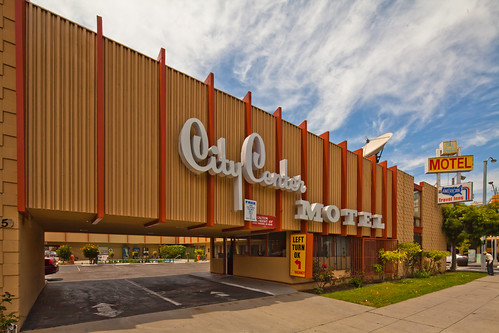
City Center Motel

City Center Motel by Chimay Bleue
City Center Motel, a photo by Chimay Bleue on Flickr.
One thing is for sure. In the world of tearing down old things, a number of people are working to document these places before they die. Darren Bradley is doing his part, and beautifully. Like with this cool Mid-Century Motel.

13 September 2011

Our Friend The Atom: Understanding The Atomic Age

I just have one thing to ask. Where was this video when I was in school? Man...it came out in the 50's and I was in school in the 80's and 90's. Why didn't they show this to me? I would have actually paid attention, and even more important... Understood.

This video though, does more than explain how the atom works. Sure, it does have some fairly unsettling parts were people are walking around with Uranium and a Geiger Counter like they are harmless. Also, there is the part about how spreading nuclear reactive debris may be a way of producing bigger and better crops, and livestock. Shucks though, those are not important. What's a little radiation amongst friends? More importantly is the way this video makes certain aspects of Mid-Century design even more clear. I mean, who cares about contaminated food, when we can talk about art.

In this video we see just how the focuses of the 50's and early 60's shaped the Mid-Century design community. Specifically speaking, the modern genre of said community. Thru the studies of these ever impressive organisms that where so new to everyone and even more important to the future, these designers copied what they saw. Sure they elaborated on them, but they did in large, copy nature.

Over the past 5 or so years, I've read and heard a lot about the organic designs that these Mid-Century designers used in there furniture, architecture, and art. However, while I never doubted it, it just never clicked what organic designs they were copying or inspired by.  This video not only taught me about the atom, but about the motion and effect on molecules. Thru these things, Mid-Century design became even more apparent to me. Are you a true enthusiast of these retro designs of the Mid-Century/Eames Era? Then, you have to really check out this video (embedded below).

On top of everything else, I found out that there is a very cool vintage book that Disney put out by the same name. I looked it up and there are a number of different prints. Some can be found on Ebay while Amazon seemed to be the only other real good option that I saw. I've really got to quit finding new books with cool Mid-Century illustrations in them. I might just end up buying something...

In case you were wondering. I saw a lot of how Eames, Charles Harper, and others were clearly influenced. 

Some of the links in this post are affiliate links. By using these links you can get what you need/want and help Amidst Mod to continue providing info and inspirations.